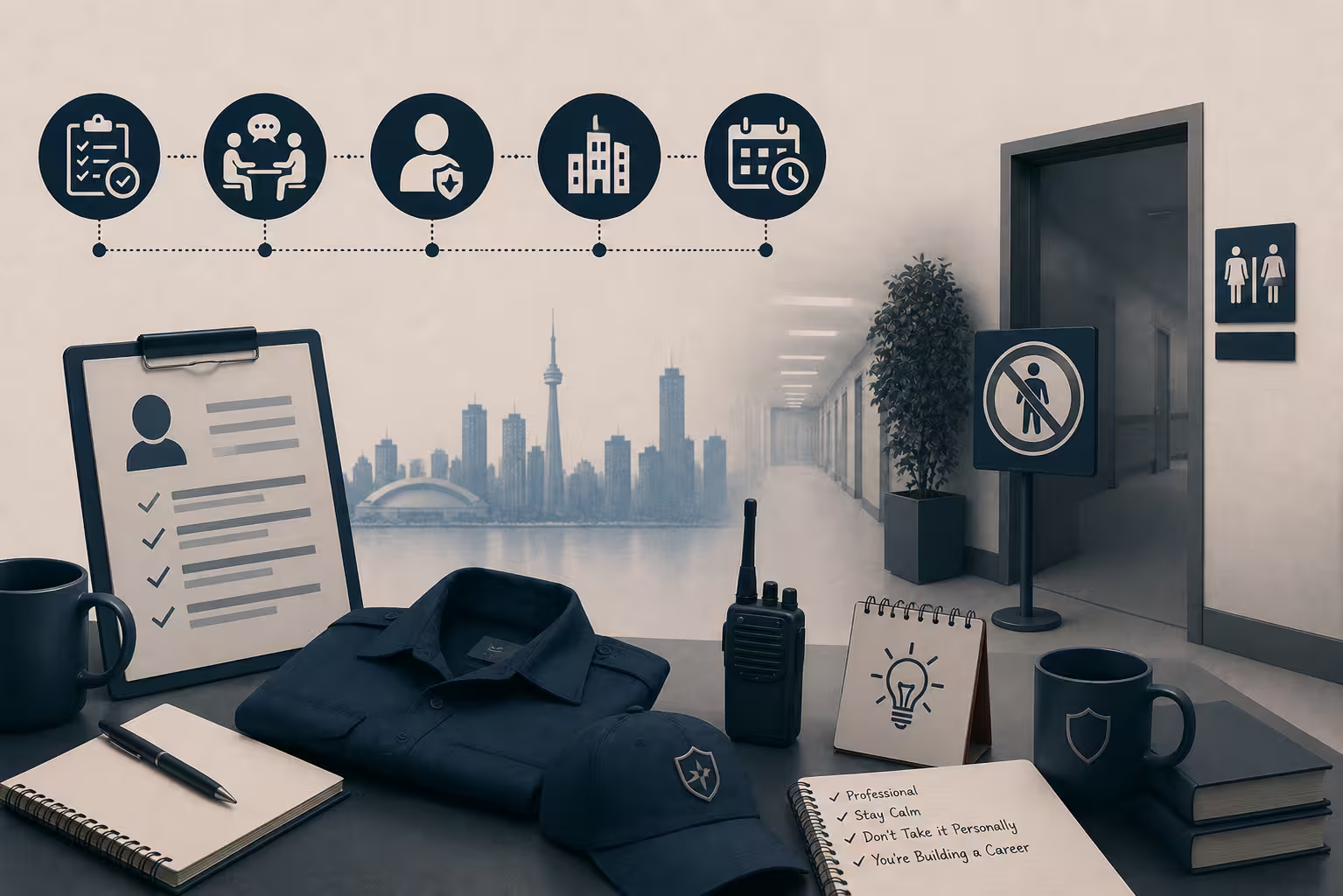


I have written a lot about the process of becoming a security guard. The training, the exam, the licence, the salary. But I have not written about what it actually feels like when you show up for your first shift and realize this is real now.
So let me tell you about my first day.
After I got my licence, I applied to about eleven companies and got called for interviews at seven of them. I went to five.
One company only offered me part-time work. A few others felt disorganized during the interview, which told me something about how they would be to work for. The company I chose stood out because they were thorough. They gave me a written test before the verbal interview, not the same material as the licensing exam, but things that actually mattered on the job. Logic, situational understanding, the phonetic alphabet. It showed me they cared about the quality of the guards they were hiring.
The verbal interview covered everything, including work I had done before coming to Canada. They asked for references, and when I told them my only references were in the country I came from, they did not hesitate. They told me they had staff who spoke the language, and they called my references internationally. It took a couple of weeks because of time zones and availability, but they did it. My references were surprised to get a call from Canada.
When I got the offer, they asked me what kind of site I wanted. Office building, hospital, different options. I asked questions about what each one involved. For example, hospital security requires certain vaccinations because of patient exposure, which I did not know until that conversation. I chose a financial district office tower in downtown Toronto.
Before I started, I had to go in for a second meeting with the account manager and site leadership at the building. It was less of an interview and more of a getting-to-know-you conversation. They told me I would be starting at the outdoor parking ramp, twelve-hour shifts, continental schedule.
I landed in Canada in mid-June. By mid-October, I had a full-time job.
Before my first day, I had to pick up my uniform and get it hemmed. I also had to buy specific boots for the site, steel-toe or composite-toe, because I was working outdoors. The company covered a portion of the cost, but it is worth knowing that some sites have specific footwear requirements you may not expect.
On my first day, I brought everything with me and changed into my uniform at the site. They gave me a locker, which is standard at most sites.
Never wear your uniform outside of your workplace. Never. Not on the subway. Not at a coffee shop. Not walking through a mall on your way to work. Do not put a jacket over it and think that solves the problem. It does not.
When you are in uniform, people see security. They do not know if you are on shift or not. They do not know which site you work at. They just see the uniform, and they will either come to you for help or, in a worst-case scenario, see you as a target. If there is a violent incident and someone is running from security or police, they may see your uniform and react to it. You have no radio, no backup, no knowledge of the situation. You are exposed for no reason.
Change at the site. Every site gives you a place to do it. There is no excuse to be walking around in uniform outside of work.
My very first shift was actually an extra coverage assignment the night before my regular schedule started. There was a city-wide event that night, and the property management had decided to close all the public washrooms in the building. They did not want to deal with the volume of intoxicated people and the issues that come with it. So they locked the doors and placed guards at every entrance to the washrooms to prevent anyone from trying to get in.
That was my post. A corridor leading to a set of locked washrooms.
I had never done a single shift as a security guard in my life. Everything I knew came from my training and my exam. That was it.
For most of the night, it was quiet. Then two women came down the corridor. They were dressed nicely, clearly enjoying the evening, a little tipsy. They asked to use the washroom.
I told them the washrooms were closed for the night. They looked at me like I was joking. One of them said, what do you mean closed? This is a public washroom. I explained that it was actually private property and that the property management had closed all washrooms to the public for the evening. I told them they would need to go outside the building to find one.
She looked at me and said, so we are dying to pee and you are not going to let us pee?
I said, correct.
She said, so you are just getting paid to not let us pee.
They both laughed and walked away.
It was a strange moment. Nobody was rude exactly, but I was standing there thinking about how people were reacting to me and the uniform. And that is when I remembered something my instructor had said during training that stuck with me permanently.
Whatever people say to you when you are wearing that uniform, they are saying it to the uniform. Not to you as a person. They do not know you. They do not see you. They see the uniform and they react to what it represents in that moment.
That one line changed how I approached every interaction for the rest of my career. If you take things personally in this job, you will burn out fast. The moment you understand that people are responding to the role, not to you, everything gets easier.
About half an hour later, a man came down the same corridor. Mid-forties, very drunk, could barely walk. He got very close to me and said he wanted to use the washroom. Same conversation. The washrooms are closed. You will need to go outside.
He did not take it as well as the two women did. It escalated quickly. He told me that if I did not let him into the washroom, he was going to urinate in the large decorative plants in the lobby of this financial district building.
I told him the washrooms were closed and I could not change that.
While this was happening, the site supervisor was watching from the mezzanine above. He came on the radio and asked if everything was okay. I told him what was happening. He said he was on his way down.
By the time I finished talking on the radio, the man had walked over to one of the planters and started pulling his pants down.
The supervisor arrived, handled the situation, escorted the man to a washroom, and then escorted him out of the building. That was his call to make, not mine. And that was my first real lesson in understanding the chain of command on a site: when a situation escalates beyond your level, your job is to communicate and wait for the person with the authority to handle it.
Later that night, I was sent to provide break relief at the main entrance. While I was standing there, a guard who had been working at the site for two or three years came over and started talking to me. He asked if I was new. I told him yes, this was my first night, and I mentioned my engineering background.
He told me he had an MBA. And then he said something I have never forgotten.
He said, do not make the mistake I made. Do not get comfortable in security. Start working in your own field as soon as you can because once you get stuck here, you cannot get out. I have been doing this for years and I thought it would be temporary, exactly the way you think right now. Get out while you can.
I thought about what he said. I understood where he was coming from. And I think he had a point for his own situation. Sometimes pushing through the hardship at the beginning and going straight for what you want does get you there faster.
But my situation was different. I needed income. I could not afford to wait. And what I did not know yet, what nobody could have told me that night, was that I would end up building a real career in this industry. Not in the way I expected, and not in a straight line, but a career that I chose to stay in.
His advice was honest and it came from a real place. But everyone's path is different. What felt like a trap for him became a launchpad for me. And the difference was not luck. It was what I chose to do once I was in.
In future posts I am going to write about what each role was actually like as I moved through the industry, from patrol to dispatch to supervision to emergency management. The first day is just the beginning. What matters is what you do after it.
Mary is the founder of Calrex Training Academy and has worked in the Ontario security industry for over 15 years, starting as a security guard and moving through roles in dispatching, supervision, and operations before specializing in emergency management and data analytics. She has hired and interviewed security guards and writes about security careers, licensing, and what it actually takes to succeed in this industry.