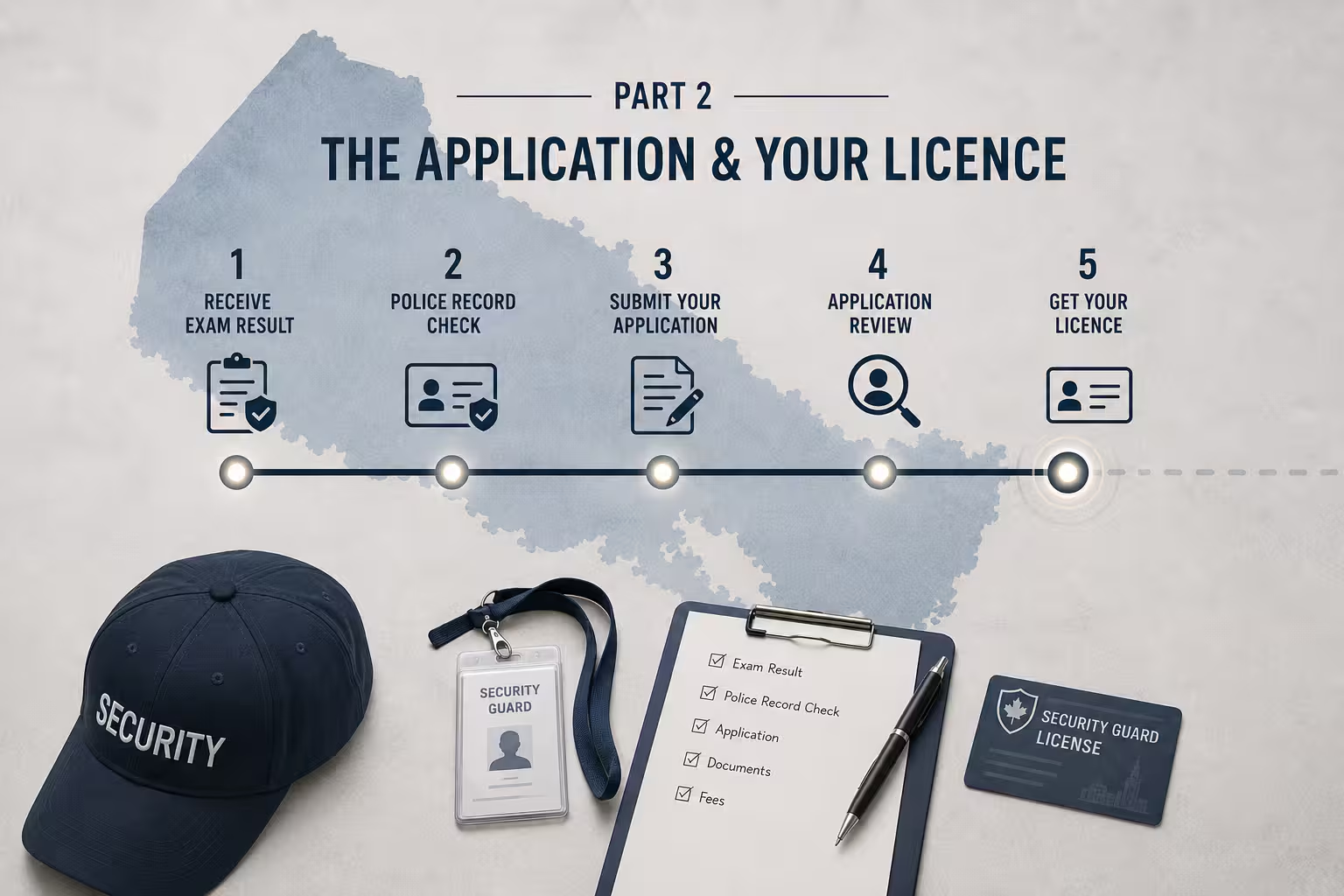


If you have not read Part 1 yet, start there. This post picks up right where that one left off.
At this point you have finished your training, you have passed the government exam, and you have your Ontario testing completion number. Now comes the part that a lot of people do not fully understand because the government websites make it feel more complicated than it actually is.
Let me walk you through it.
Before you can apply for your licence, you need to get a Criminal Record and Judicial Matters Check, also called a CRJMC. This is a background check, and it is mandatory. No exceptions.
This is something that has changed in recent years, and it is worth being clear about because a lot of people who got their licence a long time ago went through a different process. Before, the government ran the criminal check on their end as part of the application. Now you have to get it yourself and submit it with your application.
Since February 2024, the required check is specifically the CRJMC, which is more comprehensive than the older criminal record check. It includes not just convictions but also outstanding charges and certain judicial orders. You can get it from an Ontario municipal police service, an Ontario First Nations police service, the Ontario Provincial Police, or an authorized third-party provider. Since July 2024, authorized third-party providers are officially accepted, which gives you more options and often faster processing.
Two important things about timing. First, the CRJMC must be less than six months old at the time you submit your application. Do not get it too early or it may expire before your application is ready. Second, as soon as you get your exam results, that is a good time to apply for it. Online applications from authorized providers can come back quickly, and that window gives you time to get everything else ready while you wait.
If you apply online through ServiceOntario, you will need your CRJMC in digital PDF format, issued directly by the police service or authorized provider. If you only have a physical copy, you will need to apply by mail.
Once you have your Ontario testing completion number, and your CRJMC, you are ready to apply. Just to clarify: the TCN you got from your training provider was for registering for the exam. The Ontario testing completion number is what you need here for the licence application. They are two different numbers.
You can apply online through ServiceOntario or by mail. Online is faster. Note that ServiceOntario does not accept applications at its physical service counters, so do not show up in person expecting to hand anything in.
Here is what you will need to submit:
An online application typically takes up to 15 calendar days to process. A mail application takes longer, up to 30 business days. If there are any issues or missing documents, ServiceOntario will contact you and you will have up to 90 days to provide what is needed. If you miss that window, you have to start the application over.
One thing that surprises a lot of people: since September 2023, Ontario security licences are issued digitally only. There is no physical card anymore. When your application is approved, you will receive your licence by email and can also download it from your My Ontario Account. That digital licence is your proof of authorization to work, and you are required to carry it at all times while on duty.
Honestly, there is no fixed answer to this and I would rather be honest with you than give you a number that turns out to be wrong.
The timeline depends on several things. How long it takes you to feel ready for the exam. Whether you write in person or online and what availability looks like at the time. How quickly the CRJMC comes back depends on which provider or police service you use. And how busy the Ministry is when you submit your application.
When I went through the process in 2011, the whole thing from starting my course to having my licence took me roughly two months. But the regulation was brand new at the time and the system was different. Your experience may be faster or slower depending on all of the above.
What I can tell you is that if you stay on top of each step, use the gaps productively, and do not wait around between one thing and the next, you will move through it as fast as the system allows.
Your licence is valid for two years, but the expiry date is tied to your birthday. Your licence will expire on your second birthday after the date it was issued. Depending on when you apply and when your birthday falls, your first licence period could be slightly more or slightly less than two years.
Renewal is straightforward. There is no exam or additional training required. You apply again through ServiceOntario, pay the $80 fee, and get a new CRJMC. Start the renewal process at least 60 days before your licence expires. Remember you need to keep your first aid and CPR certificate up to date if you are working as a security guard.
This is where a lot of new guards stall. The licence arrives and suddenly the process that kept them busy is over.
If you used the waiting time well, as I talked about in Part 1, you already have a resume ready and a sense of what kind of work you want to do. Now it is time to apply.
A few things that will make a real difference. Know what kind of site you want to work at. Corporate offices, retail, campuses, events, industrial, residential — they are all different. Have an answer ready when an interviewer asks. And treat the interview seriously. The guards who get better sites with more opportunity are the ones who showed up prepared, not just licensed.
One thing I wish I had when I was starting out was someone to practice interviews with. Security guard interviews can vary a lot more than people expect. Some are casual conversations. Some are structured and formal. Some involve scenario-based questions where you have to think on your feet. Going in without any preparation, especially as a newcomer still learning how interviews work here, can catch you off guard.
If you can sit down with someone who has been in this industry, or better yet someone who has actually interviewed candidates themselves, even one session can make a real difference. It is not about memorizing answers. It is about knowing what to expect and feeling confident enough to show who you actually are.
Here is the complete process from start to finish:
That is it. It is a process, but it is a clear one. Follow each step, do not sit idle in between, and you will get there.
Mary is the founder of Calrex Training Academy and has worked in the Ontario security industry for over 15 years, starting as a security guard and moving through roles in dispatching, supervision, and operations before specializing in emergency management and data analytics. She has hired and interviewed security guards and writes about security careers, licensing, and what it actually takes to succeed in this industry.