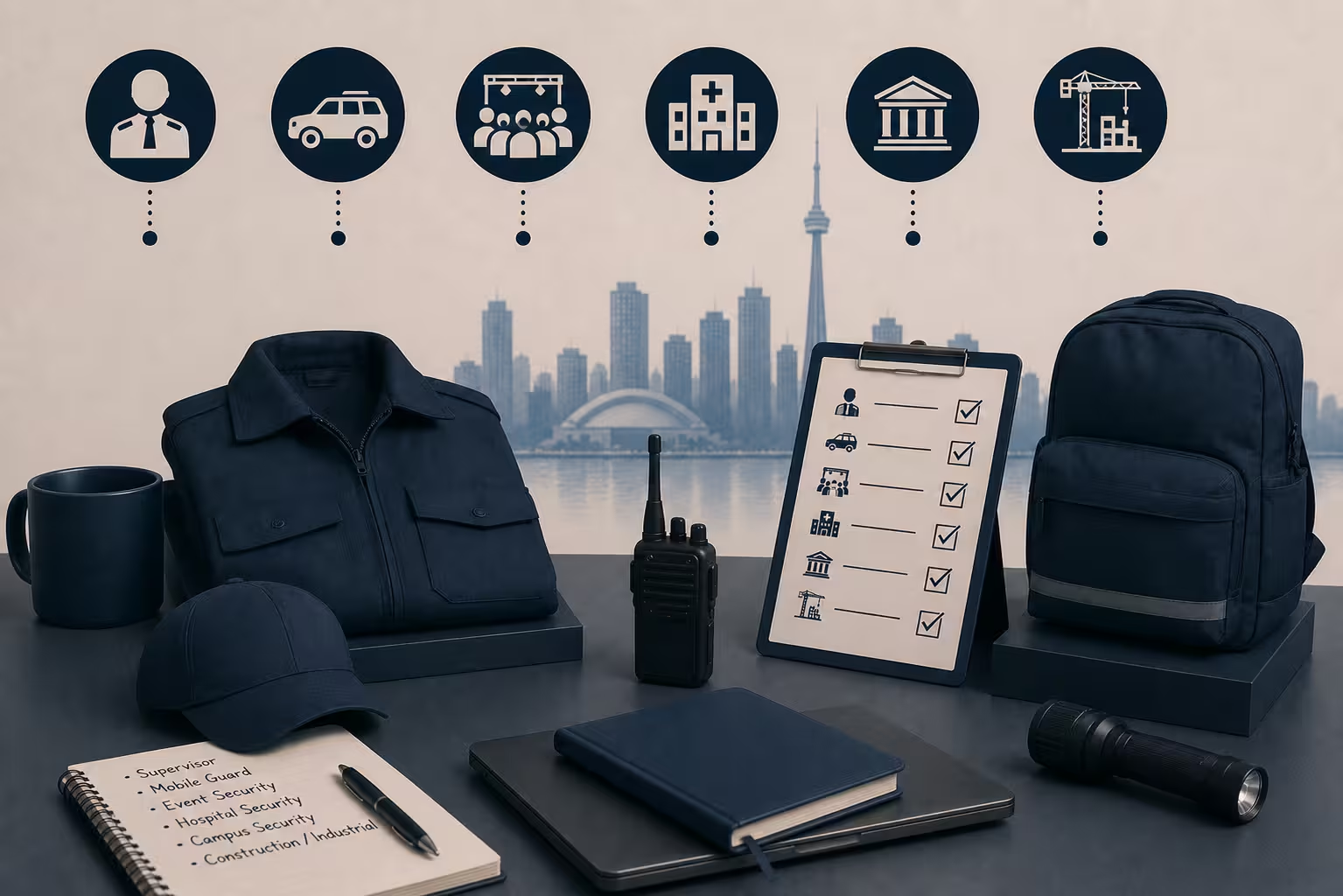


In Part 1, I covered the difference between uniform and non-uniform roles and why some positions are not ideal for new guards. In Part 2, I walked through customer service, patrol, dispatch, and bouncers. If you have not read those yet, start there.
This final part covers the roles that usually require experience and the specialized site types that come with their own unique demands. These are the positions you grow into, not the ones you start with.
Supervising in security is not that different from supervising in any other industry. You are responsible for your team, their performance, their training, and their actions. If a guard makes a bad decision, it is not just the guard who has to explain what happened. You will also be asked why it happened and what training or guidance was in place to prevent it.
The day-to-day work includes a lot of admin. Scheduling, managing vacations, moving people around to cover gaps, handling performance issues, training new staff, and making sure procedures are being followed correctly. You are also the person guards come to when they are in a gray area and do not know what to do. Your judgment in those moments matters, because the decision you make becomes the standard everyone else follows.
One part of the supervisor role that people underestimate is managing the team dynamic. In every security team I have worked with, there are people who are highly motivated and pick up every call, and there are people who coast and try to stay in the background. The supervisor's job is to make sure the work is distributed fairly and that everyone is doing all parts of the job, not just the parts they are comfortable with. That is how people grow, and it is how you build a team that actually functions.
You are also the bridge between your team and the client or account manager. When the client has concerns or questions, they come to you first. That means relationship management, networking, and communication are a big part of the role, not just operational decision-making.
Supervisor positions are a real step up in responsibility and pay. But they are also where you find out whether you want to lead people or whether you prefer to stay in a role where you are responsible for your own work only. Both are valid choices.
Mobile guards travel between multiple sites rather than being stationed at one location. You drive a route, checking on properties that may not have full-time physical security. Some of these are construction sites. Some are commercial buildings with alarm systems but no on-site guard. Some are single-guard sites where you provide break relief so the posted guard can step away.
This role requires a clean driving record and a G licence in Ontario. It also requires a broader skill set than most people expect. When you arrive at a site, you are usually alone. You need to handle whatever you find on your own, at least initially. That means you need to know how to do patrol checks, how to respond to alarms, how to deal with people on the property, how to communicate with dispatch, and how to make judgment calls without a supervisor standing next to you.
For that reason, mobile guard positions almost always go to people with prior security experience. You are essentially doing patrol, dispatch communication, customer service, and supervisory decision-making all at once, just at different locations throughout your shift.
If you like driving, prefer working independently, and are confident handling situations on your own, this can be a great fit. But it is not a beginner role.
Event security is a completely different world from everything else I have described. Concerts, sports events, festivals, conventions. Large crowds, high energy, short duration, and very little predictability.
In event security, you are always part of a team. You are never working alone. There is always a briefing before the event, sometimes in writing and always in person, where you are told which area you are covering, what you are looking for, and how to communicate with the rest of the team. Your job is to stay vigilant, spot issues before they escalate, and follow the plan.
The pace is intense. You are essentially active the entire time. There are no quiet periods where you sit at a desk. And things can get out of hand fast, especially when alcohol is involved or when crowd density creates pressure points.
Event security can be exciting if you enjoy fast-paced, high-energy environments. But it requires the ability to stay calm under pressure, work tightly with a team, and follow instructions precisely. If crowd situations make you anxious or if you prefer routine and structure, this is probably not the right fit.
Hospital security is one of the most specialized environments you can work in, and it is nothing like any other security site.
Before you even start, there are vaccination requirements you need to complete because of patient exposure. Depending on the vaccines required, there can be a waiting period before you are cleared to begin your shifts. Factor that into your timeline if you are considering this path.
The codes used in healthcare are different from what you learn in standard security training. Hospitals use color-coded emergency systems that are shared across all hospital staff, not just security. You will need to learn those on top of the standard radio and communication codes used within the security team. So you are effectively learning two systems at once.
The work itself can involve patient watch, dealing with mental health crises, responding to medical emergencies, and navigating evacuation procedures that are far more complex than in a typical office building. Hospital evacuations are tiered and depend on the ward, the type of patients, and the severity of the situation. ICU, quarantine areas, surgical floors — each has its own protocol.
If you are considering hospital security, go in with your eyes open. It is rewarding work, but the environment is emotionally and operationally demanding in ways that other sites are not. Make sure you understand what the role involves before you commit.
Campus security, at universities and colleges, was one of the most valuable experiences of my career. I say that having worked in a financial district office tower before moving to a campus environment, and the difference was enormous.
First, a quick note on how campus security is structured in Ontario, because it varies. Some campuses use a mix of contract security and in-house staff. Some have special constables alongside regular security guards. Some are entirely in-house for both uniformed and non-uniformed roles. And even campuses that are fully in-house may bring in contract security for large events. So the structure depends on the institution.
What makes campus security such a rich experience is the diversity of what you deal with. You are working with students, staff, faculty, senior leadership, international visitors, and members of the surrounding community. The age range is wide. The cultural diversity is wide. The types of incidents are wide. You are dealing with access control, residential buildings, parking, protests, events, mental health situations, and interactions with local police, all in one environment.
Campuses are also spaces where freedom of expression, diversity, and inclusion are actively practiced and discussed. You learn a lot about how to navigate those conversations and how to interact respectfully with people from very different backgrounds and perspectives. That experience translated into everything I did afterward.
If you have the chance to work on a campus, take it. It was one of the most complete learning experiences I have had in this industry, and it changed how I approached every role after.
Construction, industrial, and other high-hazard sites come with a layer of responsibility that most security roles do not: your own physical safety.
These sites may involve hazardous materials, heavy equipment, restricted zones, and environments where the wrong step can cause real harm. You may be required to wear personal protective equipment — hard hats, steel-toe boots, reflective vests, gloves, eye protection — and you need to follow those requirements without exception.
Some of these sites have a full security team. Others are single-guard posts where you are alone for your entire shift. If you are the only person on site, make sure you know who to contact in an emergency, how to reach emergency services, and what the site-specific procedures are for the hazards present. Do not assume someone will be there to help. Have your contacts ready and your procedures clear before your shift starts.
This type of work is common for mobile guards doing overnight checks on construction sites, but it can also be a full-time posting. If you are comfortable working alone, following strict safety protocols, and staying alert in environments where the risks are physical rather than interpersonal, this can be a solid fit.
There is no single best security job. The right one depends on your personality, your goals, and what kind of work environment brings out the best in you.
If you like structure and routine, a customer service desk might be the right start. If you want to be active and on your feet, patrol is a better fit. If you want to learn how everything works without going hands-on, look at dispatch. If you want to lead, work toward supervision. If you want variety and independence, mobile might be your path.
The most important thing is to be intentional about it. Do not just take the first offer and stay there indefinitely without thinking about where it leads. Every role teaches you something. The question is whether what it teaches you is moving you toward where you want to go.
Mary is the founder of Calrex Training Academy and has worked in the Ontario security industry for over 15 years, starting as a security guard and moving through roles in dispatching, supervision, and operations before specializing in emergency management and data analytics. She has hired and interviewed security guards and writes about security careers, licensing, and what it actually takes to succeed in this industry.